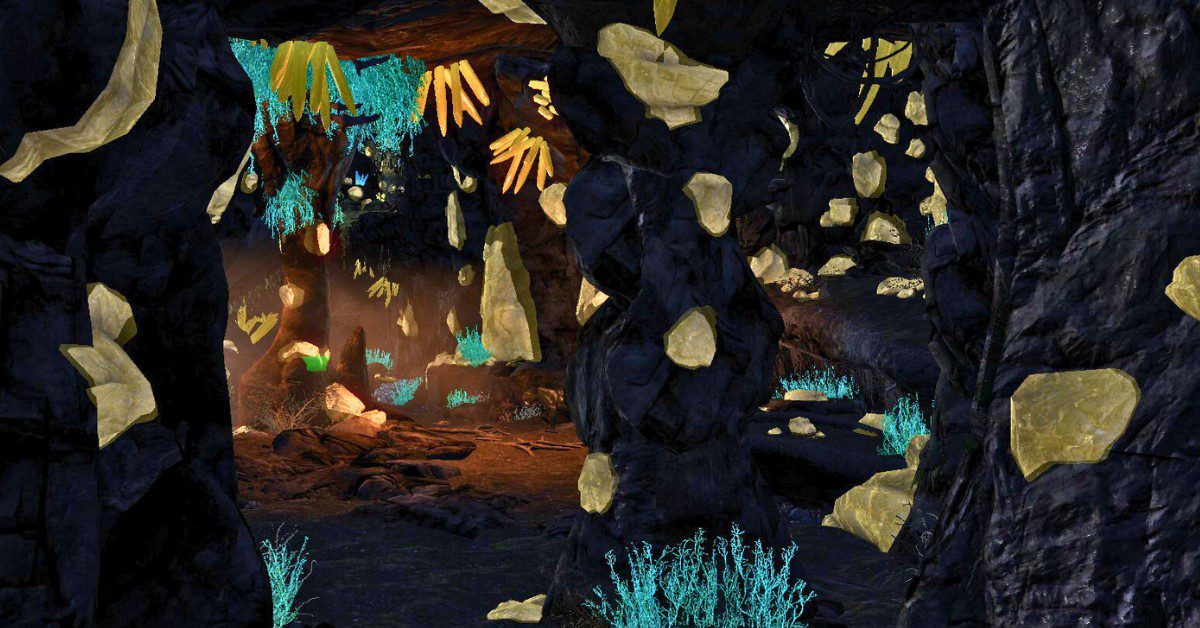
An interior cave dungeon I designed and built in the Creation Kit for Henantir’s Steamcrag, the Arcane University’s latest collaborative mod project for Skyrim Special Edition.
Mirror-Made Mausoleum is the second main interior level I’ve designed and built for Skyrim Special Edition, using the Creation Kit. I created it for the Arcane University’s latest student collaboration project, Henantir’s Steamcrag. This is also the first level design project I’ve worked on where the brief came from elsewhere, and I had no real input in the narrative or writing. I was able to create lots od environmental storytelling in the space, but by interpreting a concept rather than devising it. This was a new challenge for me, and I really enjoyed bringing the idea to life.
Brief
Henantir’s Steamcrag is a short-term collaborative modding project for Skyrim Special Edition that I worked on as part of Beyond Skyrim’s Arcane University team. The project began in November 2023 and was scheduled for public release in 2024. Since then there have been some delays in the timeline, and the mod was officially releast in August 2025.
My role in the collaboration this time around was as a level designer, and as part of the level design team I was responsible for the planning, design flow and creation of an interior level, to be known as Mirror-Made Mausoleum.
The Arcane University is made up of students and teachers from across the world, and as an HSC dev, I formed part of a smaller interior level design team who worked remotely using Discord, Skyrim Special Edition Creation Kit, Mod Organizer 2, Trello and Google Suite to complete and regularly review the project over a number of months. Each developer selected an available claim for a dungeon to work on. Having only had experience building interior cells previously, I opted for an interior dungeon that I could develop my skills from Lokir’s Tomb with.
Play Henantir’s Steamcrag
Henantir’s Steamcrag is available now on Nexus Mods.

creative process
The process for Henantir’s Steamcrag was set out clearly from the project’s initiation in November 2023. In previous collaborative projects with the Arcane University, I’ve worked as a writer, so this time around things were a bit different. I was given set of design briefs to choose from when selecting which level I wanted to design. I opted for Mirror-Made Mausoleum, which was described as follows.
A serene and colorful cave, Mirror-Made Mausoleum is a cave adorned with enormous crystals that grant this place an almost otherworldly illumination, as the light is reflected between large pieces of Welkynd and geodes rich with gemstones and ore. Feasting off the unique crystals, this cave is inhabited by the fauna usually found within the Forgotten Vale. It is located in Crystal Cavity.
With this prompt in mind, I started exploring possible concepts for the cave design, following the workflow set out by the AU level design teachers. This was more robust than previous, self-directed level design projects. I appreciated having this structure in place, as it allowed for planning, development and iterations within the scheduled development window.
I started out with a 2D paper plan in its most simple format, using shapes and arrows to plan the feel and flow of each area. After consulting with the Level Design lead and making a couple of suggested tweaks, I made a start on constructing the space in the Creation Kit.
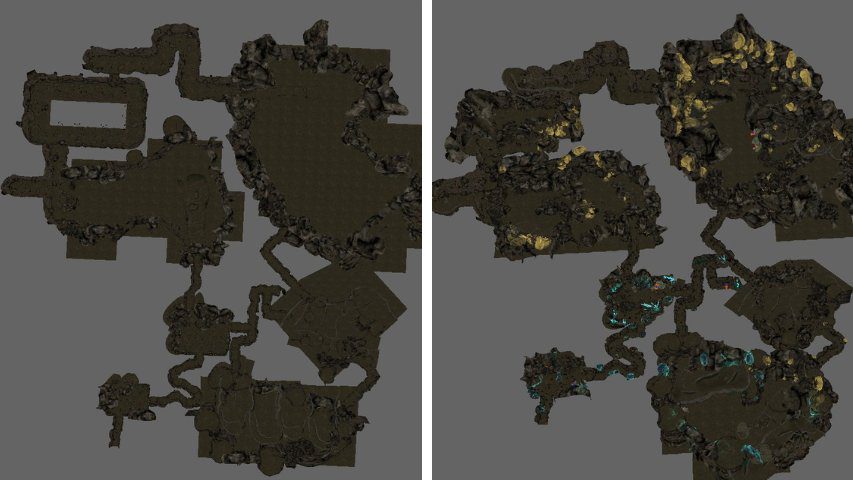
The walls and some of the floors in the cave spaces are almost entirely custom built, using kitbashed rocks and pre-existing pathway pieces for the tunnels and slopes. Pillars, cliffs and wall pieces helped me flesh out the basic map that I’d envisaged. However, many of the larger walls were created rock by rock, with crystals interspersed for effect. Hand placing and rotating each boulder and rock allowed for more natural curves and edges throughout the cave.
This was very time consuming, but I made sure that my rocks, walls and floors didn’t exceed the recommended transformation sizes, so that performance wouldn’t be imapcted. A lot of this dungeon was built according to how I felt it looked and flowed. I had a plan to work from, but I was able to be quite fluid with things, so anything I felt didn’t quite fit or work, I could easily adapt and test. I also used cliff pieces to develop different levels of height on the floor, including ramps and bridges to bring verticality into the narrative of the cave.
This creative freedom was really enjoyable and although the cave spaces are unusual in their style, I was able to tell a story with the space, so that the further you explore, the more eye-catching and dangerous the adventure becomes.
Design Decisions
I decided that I wanted to request some new crystal assets specifically for my cave. However, I knew that other departments already had a lot on in terms of workload, so I asked if a recolour of the exisiting crystals would be possible. This was done first, and allowed me to add golden hues into the cave spaces.
I also wanted to see if making spikier crystals in a complementary gold tone would be possible, so asked the 3D department if anyone would be willing to create some for me. One of the 3D team was happy to help, creating matching sets of blue and gold crystal clusters for me to place later into the development.
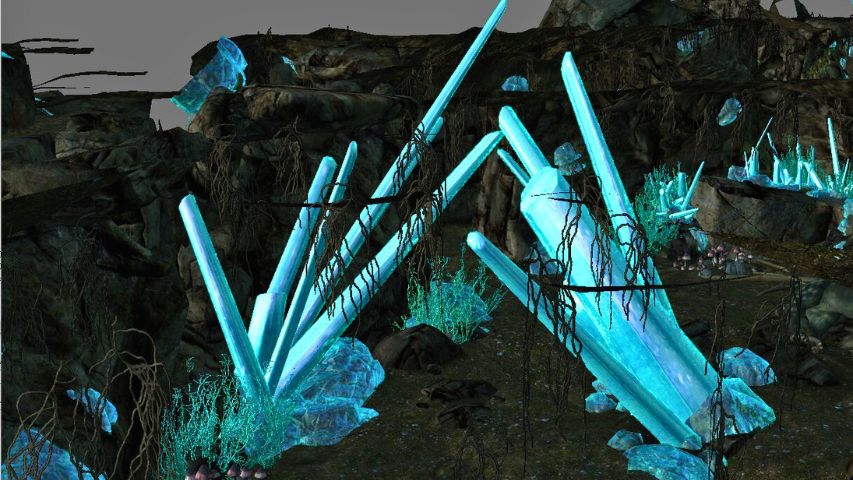
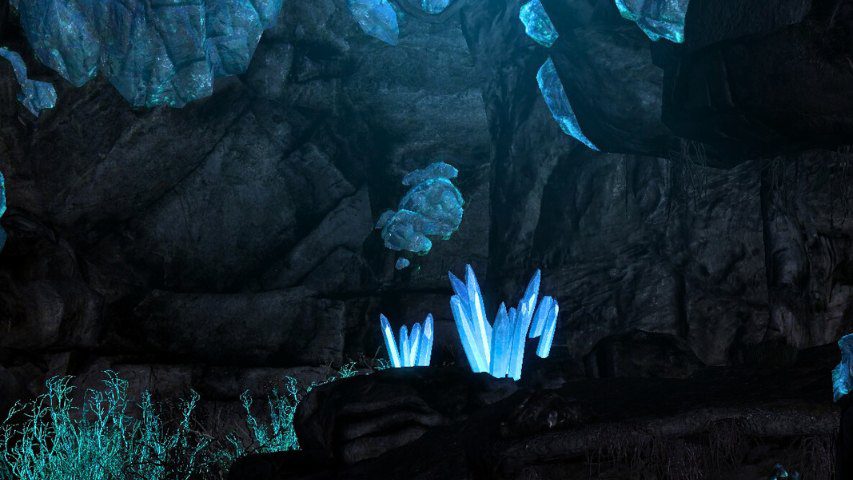
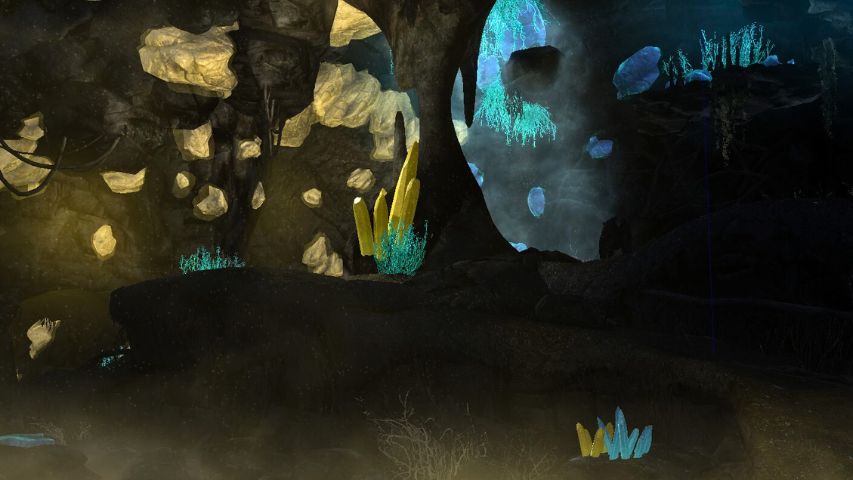
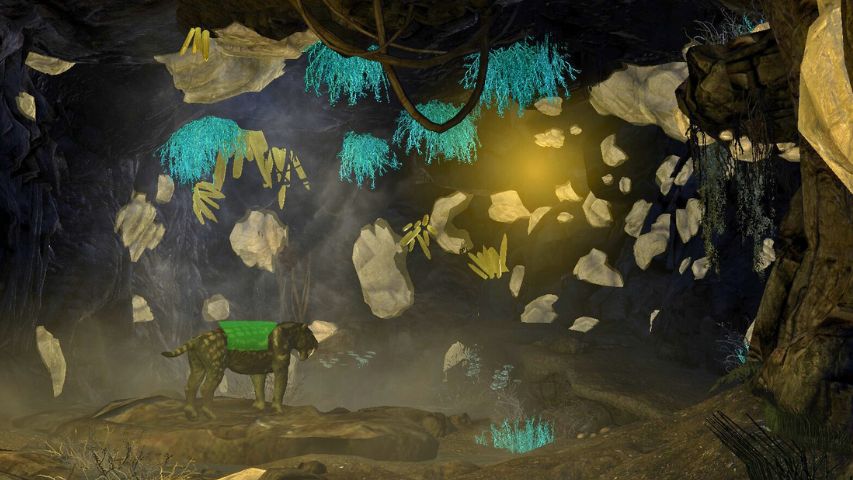
This blue and gold contrast was an interesting mixture, with some unusual effects that resulted in the eventual lighting. On the whole, my intention was to draw the player’s eye toward the promise of something different, encouraging their descent further into the cave. It’s also a direct change in temperature on the colour wheel after the relentless blues of Blackreach and the rest of the exterior space’s blue tones.
In addition to sourcing and placing these custom crystals, I created some custom lights for the project. I wanted to make sure the golden hues of the crystals really shone through the spaces, so I made three gold-amber toned omni-directional lights that didn’t cast shadows. This meant I could use them fairly generously throughout the interior, without making an impact on performance.
Other considerations were enemy encounters and what players could find or do inside the cave. I populated the space with some sabre cats, creating dens and natural rockpools to ensure they’d be able to survive in the depths. Littered nearby are the bodies of ill-fated hunters and adventurers, alongside carcasses, ore nodes and treasure chests to track down. The dungeon isn’t intended to be too combat-heavy, but the cats do present a level of challenge in amongst the hidden treasures stashed in chests and dropped by the fallen hunters.
What This Project Taught Me
This project spent a lot longer in development than Harthstone Isles. It taught me a lot about iterating on an initial concept and about how to convey a narrative through level design. I was able to collaborate with the 3D art department as well as my level design teacher in the Arcane University to achieve the final result I’d envisaged at the outset. The 2D plan was useful in helping me devise the base concept for the dungeon, but I really enjoyed developing this further in the Creation Kit once I’d pinned down the basic layout.
It was the largest interior dungeon space I’d worked on and it allowed me to work with different types of enemy spawns for combat. I enjoyed thinking this part through, as it allowed me to explore this weird world of underground sabre cats and mysterious minerals and fauna. Having the early claim prompt to work with gave me a good benchmark for the concept, but the creative freedom that resulted from this allowed for much more interesting results than anyone had anticipated! My level design teacher was very suprised at the time and effort that had gone into building the cavern space and rock walls boulder by boulder.
I also gained a better understanding of the technical demands and limitations that level design has when working in the Creation Kit. Specifically, understanding performance-related placements of things like lights, portals, roombounds and occlusion planes. This was fairly new to me when working on a dungeon of this scale, and it also made me appreciative of why twisting tunnels present complex problems for managing performance and rendering at times!
I really enjoyed working on Mirror-Made Mausoleum. It gave me a much stronger grasp of how a space can be used to communicate intent and experience, even in the absence of quest content. In future, I’d probably put some of the hidden treasures and chests a little more front and centre, but they’re there for the eagle-eyed cave delvers to find! I’d also like to further develop my understanding of combat design and enemy encounters in an interior space, to ensure my dungeons feel balanced and have a good sense of pacing.